

The path to engineered luck

I have never considered myself lucky. In fact, I remember a funny story from when I started dating my now-wife. I’m not sure how we got to that topic, but I clearly remember her telling me, straight to my face, that I’m not a lucky person. She didn’t mean it as an insult, more as an observation, but it still felt a little uneasy to hear something like that…
For years, I’ve tried to rationalize luck—to see if it’s something I could attract or engineer. In tech, people believe luck can be engineered. Just spend an hour on Twitter and you’ll see phrases like “maximize your surface area of luck,” “stay in the game long enough to get lucky,” “luck is when preparation meets opportunity,” and “expose yourself to asymmetric bets.” But these lines are usually spoken by people who have already made it, and thus carry a heavy dose of survivorship bias. So I kept asking myself: what actually is luck, and what mental models can help me navigate it?
Luck as a binary mental model
This framework is simple, but it has served me well so far. It was developed by the only truly lucky person I know: my wife. We use it when meeting new people. After a quick look, she can tell, with surprising accuracy, whether someone is likely to be lucky or not in their daily life.
At first, I challenged her a lot. I couldn’t understand how something so vague, like a brief meeting, could lead to an accurate observation. And yes, she has been wrong a few times. But the more time we’ve spent together, the more I’ve realized she’s right more often than not.
What she calls “luck” really comes down to the energy people give off.
Are they smiling, positive, non-judgmental, charismatic, and pleasant to be around?
If so, they’re likely lucky.
She is that kind of person herself. And just by being around her, I’ve started to experience more of these small but meaningful moments of luck in daily life: free desserts at restaurants, super early check-ins at hotels (literally this morning at 7 a.m., without paying extra fees!), seat upgrades on flights, and strangers going out of their way to help us.
One example that comes to mind took place on a recent trip to Japan, where we met a friend at a tiny izakaya in Tokyo. The owner, an elderly lady, ran it with her daughter. Japan, as you might know, is a reserved culture. Yet my wife made a point of expressing how much she enjoyed the food and atmosphere whenever the owner passed by our table. Not surprisingly, the owner responded with complimentary dishes, and when we were about to leave, gave us a beautifully packaged gift. We ended up bowing and thanking each other for a few minutes, fully aware of how special the moment was.
Watching my wife, I’ve started taking small steps myself, to tone down my Eastern European native frown, to be a little more cheerful, to show respect and appreciation in my own small ways. It has only led to positive experiences.
Serendipity on the streets of NYC
I read this story on a recent trip to New York, which is probably why it made such an impression on me. It’s about Barnett Helzberg Jr., who considered himself a lucky man.
Back in the 90s, he built a chain of successful jewelry stores that made around $300 million in annual revenue. And like most stories about luck, one day he had a one-of-a-kind encounter.
As he was walking past the Plaza Hotel in New York, he heard someone call out, “Mr. Buffett.” I doubt Buffett was as well-known back then as he is today, but even if he was, most people would have just kept walking. Helzberg didn’t. He introduced himself, correctly guessing it was Warren Buffett. That random encounter eventually led to Buffett acquiring his company.
If it weren’t for that chance meeting, we might never have heard of Helzberg’s success but one thing is certain: having the agency to start that conversation changed the course of his life.
As Stanford psychologist Alfred Bandura once said, “Some of the most important determinants of life paths often arise through the most trivial of circumstances.”
Luck in academia
I did some digging, and as expected, there’s real research on how some people are consistently luckier than others. Much of it reminds me of my wife’s mental model, some people are simply better at creating and noticing chance opportunities.
One study I found particularly interesting gave volunteers a newspaper and asked them to count the photos inside.
The unlucky participants took about two minutes.
The lucky ones needed just seconds. Why?
Because on the second page was a huge message:
“Stop counting – there are 43 photographs in this newspaper.”
Unlucky people missed it. Lucky people spotted it.
If you kept reading, later in the paper there was another message:
“Stop counting, tell the experimenter you’ve seen this, and win $250.”
Again, the unlucky group overlooked it.
I’ve seen this in my own family. I often feel my parents are unnecessarily unlucky at times, they’re so anxious and stressed about most things that it clouds their ability to see clearly and attract good fortune. My wife, as a self-proclaimed lucky person, sits on the opposite end of the spectrum. Watching both sides go through life under similar circumstances has been eye-opening: same world, similar experiences, completely different outcomes.
Of course, it’s easier said than done to change your personality. The older you get, the harder it becomes. Disappointments, unfulfilled dreams, and an increasingly unhealthy body all take their toll.
But pushing through all that is worth it. It leads to a better quality of life. Having a great example around me has helped me increase my own surface area of luck.
That chain of thought led me to look for even better mental models to guide my journey.
That’s when I found Naval’s idea of the four kinds of luck.
The four kinds of luck
To be frank, Naval wasn’t the first to come up with this model. It was first brought to my attention by Marc Andreessen and later it has been recycled many times by countless content creators on the internet.
But what Naval did exceptionally well was to compress and articulate it clearly, which was instrumental in helping me discover and truly understand this mental model.
The four kinds of luck are essentially a ladder: from luck that happens to you by chance, to luck you learn to engineer for yourself.
Blind luck
“Chance I is completely impersonal; you can’t influence it.”
— Dr. James H. Austin
This was my understanding of luck growing up, and I assume it’s what most people are familiar with. The simplest way I can explain it is to imagine finding a twenty-dollar bill on the floor. We call that blind luck because the probability of replicating that scenario is minimal. Even if you start hanging around banks and ATMs, I doubt you’ll be able to make it happen again.

Luck from motion
“Keep on going and chances are you will stumble on something, perhaps when you are least expecting it. I have never heard of anyone stumbling on something sitting down.”
— Charles Kettering
I remember early in my career, when I was trying to figure out what I wanted to do with my life, what I was good at, and what would generate the best return on my efforts. I had no idea, and no one to guide me. So I did something simple that came intuitively to me: I stirred the pot.
I went to any event I could find, volunteered for any organization that would take me, and joined business competitions just to learn. Deep down, I knew that staying home watching movies or sleeping in wouldn’t create luck, but being active and exploring new activities just might.
That’s the most accessible type of luck. Anyone can tap into it if they have enough agency.

Luck from preparation
Now it gets very interesting.
“Chance favors the prepared mind.”
— Louis Pasteur
This type of luck is best illustrated by the story of Barnett Helzberg Jr. I shared earlier. First, he could recognize Buffett’s name, which means he had done a fair bit of reading in a time when information wasn’t nearly as accessible as it is today. Second, he had already built a successful business over many years, which made him someone Buffett would actually be interested in. He was well positioned to win the moment he decided to introduce himself.
We often see people calling famous founders or investors lucky because of their success (in the context of “blind luck”). And while every once in a while that might be true, I haven’t met many successful people who aren’t exceptional at what they do. When you reach a certain level in your journey, you start seeing things others don’t. Your receptivity and intuition become sharper than that of the average person.
Because I work in tech and build products for a living, I often notice new and interesting developments earlier than my friends. The more I work in the field, the more I build intuition about what’s worth learning, which technologies to keep an eye on, and when it might be time to pivot my career. The result is that you become more sensitive to luck, not by chance, but through your specific knowledge and accumulated experience.

Luck through mastery
“We make our fortunes and we call them fate.”
— Benjamin Disraeli
This, being the top of the ladder, is the hardest luck to come by. At the same time, it’s probably the most important one because I truly believe it can be engineered over a long enough horizon.
The idea here is that we all have unique interests and skills. Realizing what you’re naturally good at, and genuinely enjoy doing, gives you a competitive advantage. It’s very hard to compete with people like that, and they often end up becoming the top 1% in their field. Once you reach that level, people start noticing you. If you’re an incredible architect, for example, clients will start seeking you out, offering projects you didn’t even know existed, and paying you more than your younger self ever thought possible, all because of your unique taste and skill.
The same applies in tech. Recently, we saw Meta acquiring a few AI researchers at mind-breaking sums, with compensation packages reaching up to $1 billion. While that might sound absurd to the average person, there are only a handful of people in the world who can do that kind of work. All the individuals Meta tried to poach have actually contributed significantly to major breakthroughs in AI.
Once you become the best in the world, other people’s luck becomes yours. Even if Zuckerberg was lucky to start Facebook (which I don’t believe), and later became the world’s third-richest person (at the time of this writing), his billions are now being spent to attract the top 1% of talent in AI. In that sense, his luck became their luck, a byproduct of reaching such a status.
I genuinely believe that when you get to that level, luck starts to look predictable and consistent, which is why people often dislike those who are overly successful. If you haven’t done the work or been in that position, it’s hard to understand that level of success.
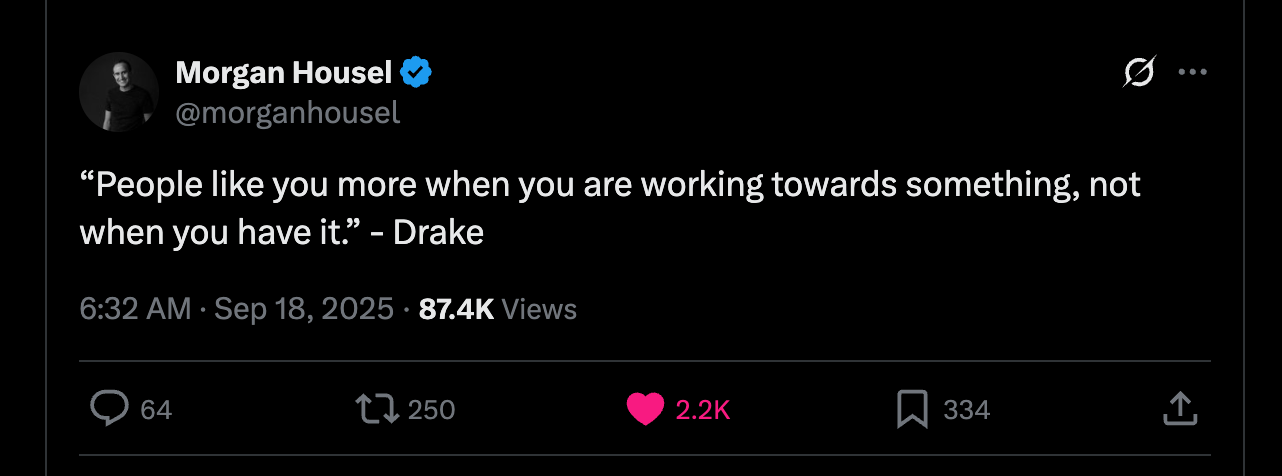
That’s the kind of luck I aspire to have one day.
Engineering luck
Going back to the beginning of this essay, I do think my wife’s mental model fits somewhere under “luck from motion.” In her case, her sheer energy, good attitude, and kindness keep her constantly stirring the pot, and that, in turn, creates a steady stream of serendipitous opportunities in our lives. Over time, she’s also become skilled at recognizing other people with similar qualities who seem to attract the same kind of luck. It has even become a fun little game for us, guessing who’s likely to be lucky or not, simply based on their attitude and approach to life.
One way or another, I’m grateful for that kind of luck. It brings a lot of joy and gratitude into our lives, and I think it’s the easiest form of luck anyone can cultivate as it follows a formula like this: curiosity + agency + kindness = luck from motion.1
In my case, a few years ago I started noticing that I had reached level three, but I spent long time being stuck at level two, literally forcing into existence tiny bits of luck. My twenties were all about being curious, exploring and experimenting with as many things as I could, which was my version of “luck from motion.” It helped me discover tech, even though I come from a family of blue-collar workers who, to this day, find it confusing that I make a living behind a computer.2
But the longer I spent in tech, the more I began to notice patterns, things that felt obvious to me but not to others. A few examples come to mind:
Going through a lot of pain to move to Denmark for my studies, despite not having the financial means or a single relative who had ever graduated from university.
Moving to Asia at a time when it wasn’t an obvious choice. Most of my university friends went to Western Europe or the U.S., while I was one of the few who went east, a decision that, in hindsight, accelerated my career.
These days I don’t mention it often, but I spent about six years working in the hospitality industry. During that time, I found myself reading far more than most of my peers, which eventually led me to discover tech, a shift that brought not only better financial upside but also a much more fulfillment in my career.
I think the formula here looks something like this:
experience + knowledge + observation = non-obvious associations.
This, of course, leads me to reflect on what it takes to reach level four.
I wish I had the answer, it’s a bit premature but based on what I know today, I think the formula looks something like this:
specific knowledge + reputation + agency = luck through mastery.
Specific knowledge is the intersection of your personal interests and skills, continuously fine-tuned until you become the best in the world at what you do.
Reputation matters because it allows opportunities to find you, not the other way around.
Agency because it’s entirely within your control and arguably the biggest lever a person can have. It’s what helps you reach level four and keeps you from becoming complacent.
This gives me the conviction that luck can, in fact, be engineered, not through magic or chance, but through a clear and achievable roadmap.
The more I think about it, the more I realize that the formula isn’t deterministic. Some variables can be swapped or replaced with others that lead to similar, or even greater, levels of success. Kindness works miracles in my wife’s case, but for others, agency and competitiveness have done wonders. And then there’s risk, introduced at the right time, it can help you leapfrog people who might be lucky but not willing to take bold chances. It’s a complex formula. Rather than trying to solve it, I’ve chosen to follow the one I see working daily, the one grounded in kindness, because it continues to bring real benefits to our family.
On a visit to Bulgaria a few months ago, a relative of mine asked me bluntly how I could be so busy all the time. What could there possibly be to do, day in and day out, on a digital product? He found it both confusing and slightly amusing that we have a big team working hard all the time to deliver value to our users and clients. In his worldview, there’s only one kind of real work, the kind you do with your hands, the kind that’s easy to see and understand (¯\(ツ)/¯)